
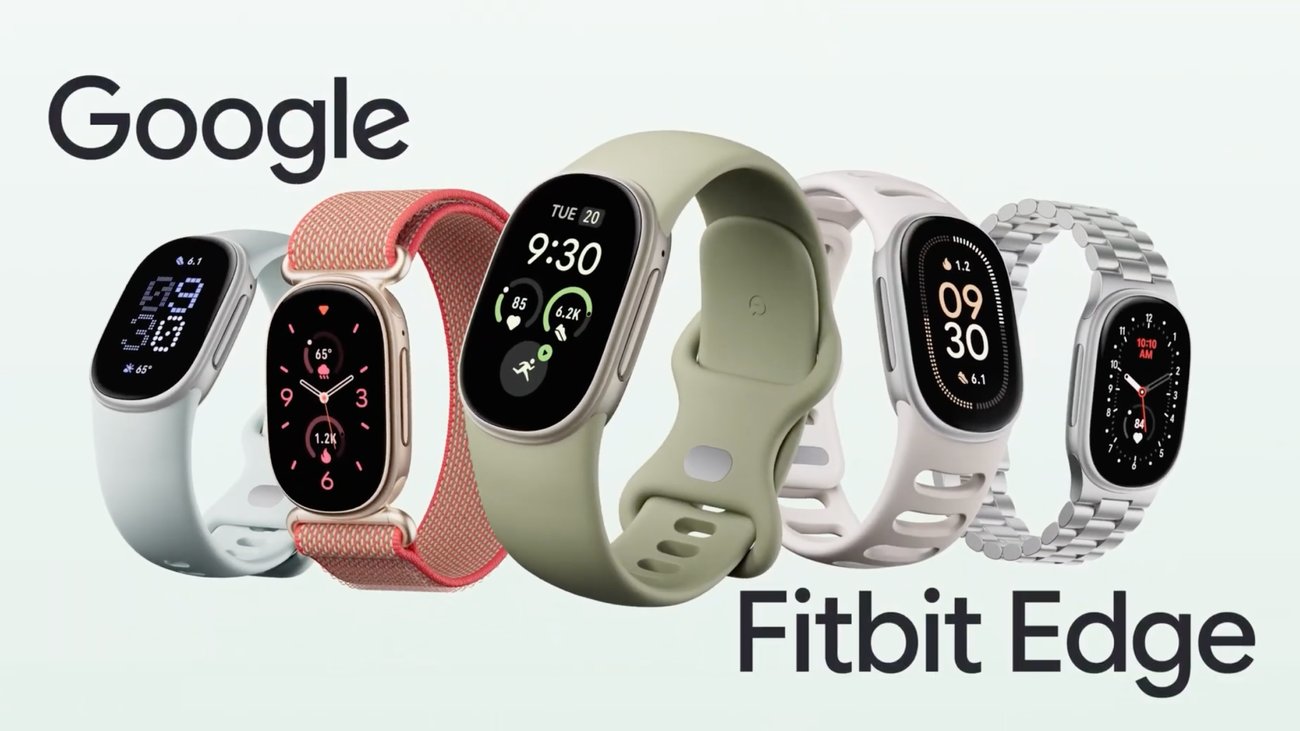
Google now sells three quite different Fitbit trackers. The new Fitbit Edge is the flagship, with a big screen, built-in GPS and a replaceable battery. The Charge 6 is the familiar screen-and-GPS band that's been the default pick for years. The Fitbit Air drops the screen entirely and is built to disappear on your wrist around the clock.
All three claim up to a week of battery, which makes the choice less obvious than it looks. This guide compares them using Google's own pages, explains where they really differ, and tells you which one fits which kind of person. Where Google hasn't published a spec, we say it's not confirmed yet rather than guess.
We only recommend what we'd use.
Quick verdict
- Fitbit Edge: for runners, hikers and anyone who wants the biggest screen, GPS and an altimeter, and likes the idea of a tracker you can repair.
- Charge 6: for people who want a screen, GPS and tap-to-pay at a lower price, from a model that's already proven.
- Fitbit Air: for people who want health and sleep data without a screen, in the smallest and lightest package, at the lowest price.
Prices and release dates
Google announced the Fitbit Edge on 12 October 2026. It costs $179.99, and preorders are open now on the Google Store and at retail partners. Google says it reaches shelves on 27 October 2026. A special edition sells for $219.99. Google includes 3 months of Google Health Premium with the Edge.
The Charge 6 is listed on the US Google Store at $159.95. The Fitbit Air starts from $99.99 on the US Google Store, which also offers it as 4 payments of $25.
In South Africa: we didn't find official local pricing for these trackers on Google's pages, so check local listings before you consider an import.
Google hasn't said whether the Charge 6 stays on sale long term now that the Edge is here. For now it's still listed.
Spec comparison
| Spec | Fitbit Edge | Charge 6 | Fitbit Air |
|---|---|---|---|
| US price | $179.99 | $159.95 | From $99.99 |
| Screen | AMOLED, 1.3in | AMOLED | None |
| Battery | Up to 7 days | Up to 7 days | Up to 7 days |
| Charging | 90 min full; 1 day in 5 min | 0 to 100% in 2 hours | 0 to 100% in 90 min |
| GPS | GPS + Galileo | GPS + GLONASS | Not listed on Air specs |
| ECG | Yes | Yes | Not listed on Air specs |
| NFC payments | Not listed on Edge specs | Yes | Not listed on Air specs |
| Thickness | 11.6mm | 11.20mm | 8.3mm |
| Weight | 17.7g (32g with band) | 30g | 12g with band |
| Water | 5 ATM + IP68 | 50m (5 ATM) | Up to 50m |
| Repairable | Replaceable battery | Not stated | Not stated |
A few gaps remain. Google's Edge tech specs now list weight (17.7g without a band, 32g with one) but still do not mention contactless payments or NFC. The Air's tech specs page still does not list GPS or an ECG app. If either of those matter to you, recheck the Google Store pages before you buy.
Design and screen
This is the clearest difference between the three.
The Fitbit Edge has a 1.3in always-on AMOLED colour display with Gorilla Glass 3, according to the Google Store tech specs. Google's announcement calls it Hybrid OLED and describes it as its "largest and brightest tracker screen yet". Since the Charge 6 is AMOLED too, the real difference is size: Google says the Edge has 46% more viewing area than previous Fitbit trackers. Google's announcement called it 11.5mm thin; the Store tech specs list height as 11.6mm. Google also says its case is 45% lighter than the Apple Watch Series 12's. That comparison is Google's own claim.
The Charge 6 uses an AMOLED display covered by Gorilla Glass 3. It measures 36.73 × 23.09 × 11.20mm and weighs 30g, so it's a slim band that most people already know.
The Fitbit Air has no screen at all. It measures 34.9 × 17 × 8.3mm and weighs 5.2g without a band, or 12g with one. You check your data in the Google Health app on your phone. That's the whole point: nothing to light up at night and nothing to glance at during a meeting.
Edge colours are Obsidian, Fog, Olive and Canyon. It works with Android 11 or later and iOS 16.4 or later.
Fitness tracking
If you train outdoors, GPS is the feature that splits these trackers.
The Edge has built-in GPS, and Google claims up to 40% better accuracy than previous generations. It also adds an altimeter, more than 50 exercise modes and automatic recognition of up to 100 workouts.
The Charge 6 has built-in GPS plus GLONASS, so it can track runs and rides without your phone.
For the Air, GPS still isn't listed on Google's tech specs page (checked 16 Oct 2026), so treat built-in GPS as not available until Google lists it. Google says the Air stores 7 days of minute-by-minute motion data and records heart rate at 2-second intervals, and it tracks steps and calories through the Google Health app.
Health sensors
All three cover the basics of heart and sleep tracking, but the details differ.
- Fitbit Edge: ECG app, continuous optical heart rate, a skin temperature sensor and heart rate variability (HRV). It also adds Health Guardian trends for blood pressure and insulin resistance.
- Charge 6: optical heart rate, SpO2, the ECG and EDA Scan apps, and skin temperature variation.
- Fitbit Air: heart rate, HRV, breathing rate, SpO2 and sleep stages, via the Google Health app. An ECG app still isn't listed on its tech specs page (checked 16 Oct 2026).
A word on Health Guardian. Google presents these as trends, not medical readings, and availability depends on your region. They're not a diagnosis, and a tracker isn't a replacement for a blood pressure cuff or a doctor.
Battery and charging
All three claim up to 7 days of battery, so the real difference is charging.
The Edge supports fast charging: Google's Store tech specs say about 90 minutes to a full charge, and a low-battery top-up of 5 minutes for up to a day of use. Google's announcement also pointed to a 30W adapter sold separately for the fast-charge path. If you're not sure your current charger is up to it, our USB-C charger guide explains what to look for. The Edge is also Google's first repairable tracker, with a replaceable battery, which matters if you keep devices for years.
The Charge 6 goes from 0 to 100% in two hours.
The Air charges from 0 to 100% in 90 minutes, and a quick charge gives a day of use in 5 minutes. It connects over Bluetooth 5.0.
The subscription question
Google says the Edge's coaching features need a Google Health Premium subscription, sold separately. Google includes 3 months of it with the Edge. We didn't find the Premium price on the official pages we checked, so we're not quoting one. Before you buy, check which of the features you want sit behind the subscription, and budget for it if they do.
What to check before you buy
A few practical checks will save you a return.
- Your phone. The Edge needs Android 11 or later, or iOS 16.4 or later. Check the Google Store page for the Charge 6 and Air if your phone is older.
- Your charger. Google's Edge charging times assume a 30W adapter, and that adapter isn't in the box.
- The features you'll actually use. If you never run outdoors, built-in GPS may not be worth paying extra for. If you never pay with your wrist, NFC won't matter either.
- The subscription. Check which coaching features sit behind Google Health Premium before you decide the Edge is worth the step up.
- Your wrist. The Air's spec page lists the wrist sizes its band fits, so measure yours and check the Google Store page for each tracker before ordering.
Alternatives
If you want a full smartwatch rather than a tracker, our Apple Watch Series 12 vs Ultra 4 comparison is the place to start. If battery life on long outdoor trips is your main concern, our Garmin Enduro 4 buy, wait or skip guide covers a watch built for that.
Which to buy
Quick decision guide:
| You want | Buy | Why |
|---|---|---|
| Big screen, GPS, altimeter | Fitbit Edge | Most complete tracker of the three |
| Screen, GPS and tap-to-pay | Charge 6 | NFC confirmed, lower price |
| No screen, lightest wear | Fitbit Air | 12g with band, from $99.99 |
| A tracker you can repair | Fitbit Edge | Replaceable battery |
Buy the Edge if you'll use the GPS, altimeter and bigger screen, and you're happy to wait until 27 October. Buy the Charge 6 if contactless payments matter today, because it's still the only one of the three where Google lists NFC. Buy the Air if you mostly care about sleep and recovery data and want something you'll forget you're wearing.
FAQ
Which Fitbit has the best battery?
All three claim up to 7 days. The Edge and the Air can get a day of use from a 5-minute charge; the Charge 6 takes two hours for a full charge.
Does the Fitbit Air have GPS?
Built-in GPS still isn't listed on Google's Air tech specs page (checked 16 Oct 2026).
Is the Charge 6 being discontinued?
Google hasn't said so. It's still listed on the US Google Store at $159.95.
Do I need a subscription?
For the Edge's coaching features, yes: Google says they need Google Health Premium, sold separately.
Source: Google
Sources: Fitbit Edge announcement (Google blog, 12 Oct 2026), Fitbit Edge tech specs (Google Store), Fitbit Charge 6 tech specs (Google Store US), Fitbit Air tech specs (Google Store US), Fitbit Air product page (Google Store US). Facts checked 16 Oct 2026 (SAST). Edge weight and full charge time filled from Google Store Edge tech specs.