
SpaceX caught Starship's upper stage with its launch tower for the first time on 14 November 2026, after more than 20 hours in space. It was not a full recovery: the Super Heavy booster was not caught and was destroyed over the Gulf of Mexico.
This Starship upper stage catch is still a real milestone. Here is what happened on Flight 15, what was and was not recovered, and why it matters for reusable rockets and Starlink.
We only recommend what we'd use.
Last updated: 17 November 2026
The short answer on the Starship upper stage catch
According to SpaceX's Flight 15 page, Starship lifted off from Starbase, Texas, on Friday, 13 November. On Saturday, 14 November, about 22.5 hours later, the upper stage, called the Ship, flew back to the same site and the tower's arms "closed to catch Starship for the very first time."
Spaceflight Now puts the catch at 3:20 p.m. CST, which is 21:20 UTC or 23:20 SAST. The booster was a different story: it aborted to an offshore landing, and its flight termination system was triggered.
What was caught, and what was not
| Stage | Outcome on Flight 15 |
|---|---|
| Starship upper stage (Ship 42, per Spaceflight Now) | Caught by the tower arms at Starbase on 14 November |
| Super Heavy booster (Booster 22, per Spaceflight Now) | Not caught; diverted offshore and destroyed by its flight termination system |
SpaceX has caught Super Heavy boosters with the tower on earlier flights, but The Verge reports this was the first successful tower catch of the Ship itself. The tower and its arms are nicknamed Mechazilla. Note that the planned timeline on SpaceX's page still lists a booster catch; the official account of the flight says that catch was aborted.
How Flight 15 unfolded
Spaceflight Now reports liftoff from Pad 2 at about 4:47 p.m. CST on 13 November (22:47 UTC, or 00:47 SAST on 14 November). SpaceX's page gives mission elapsed times rather than a clock time.
- Booster: all 33 Raptor engines lit at liftoff. SpaceX says the boostback burn used 32 of 33 planned engines and ended early because of low fuel mass, with the root cause under investigation. An automated abort then sent the booster offshore.
- Ship: reached orbit and deployed 26 Starlink V3 satellites. SpaceX says it made contact with every satellite and that they are beginning to raise their orbits.
- Coast: SpaceX describes more than 20 hours of monitoring in space; CNBC and Spaceflight Now report 14 orbits.
- Return: a single sea-level Raptor engine fired for the deorbit burn. Three Raptors then performed the landing flip and slow descent into the tower arms.
Why the upper-stage catch matters
Reusing a rocket means getting both stages back in a condition to fly again. Booster catches had already been shown. Flight 15 added the harder half: an upper stage returning from orbit to the tower. Spaceflight Now calls it the first time the upper stage of an orbital launch vehicle has returned to Earth, and a crucial step toward a fully reusable Starship.
It is a milestone, not a complete reuse demonstration, because this flight tried to recover both stages and recovered only one. SpaceX has not said whether Ship 42 will fly again. CNBC notes that Starship is meant to expand Starlink and, later, support NASA lunar missions. Those are goals, not results yet.
Big flight claims are worth checking against what was actually shown, as we did with what the Tesla Roadster demo actually proved and how the Roadster's flight hardware is supposed to work. Here, the official record and three independent outlets agree on the catch.
What happened to the booster
SpaceX says low fuel mass cut the boostback short, an automated abort sent the booster offshore, and the flight termination system was triggered after the landing burn as it hovered over the Gulf. Spaceflight Now and CNBC report it exploded before reaching the water. The root cause is still under investigation, and Spaceflight Now notes that Version 3 of Super Heavy has not yet made a successful return. SpaceX has not announced a date for the next attempt.
What Flight 15 also delivered
Beyond the catch, Flight 15 was a working Starlink mission, with 26 V3 satellites deployed and contact reported with each one. If you follow satellite internet, see how Starlink compares with Amazon Leo.
Starship Flight 15 FAQ
Did SpaceX recover the whole rocket? No. Only the upper stage was caught. The booster was destroyed offshore.
Is this the first tower catch? No. Boosters have been caught before. It is the first tower catch of the Starship upper stage.
When is the next flight? SpaceX has not announced a date.
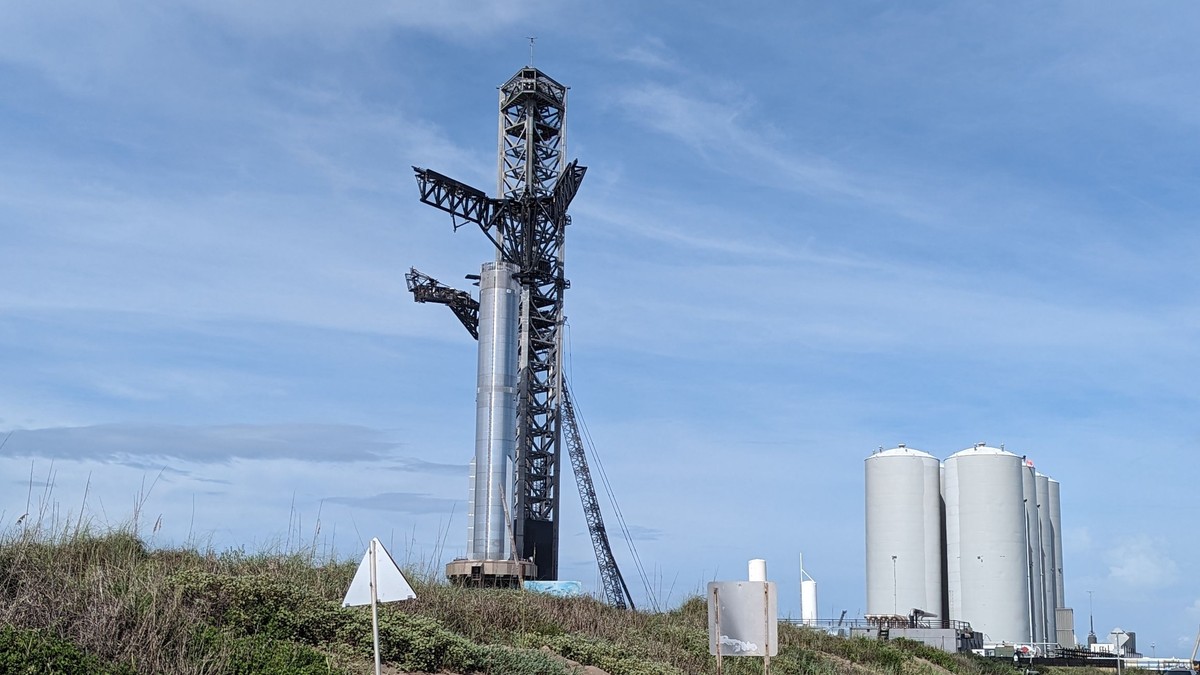
Featured photo: The catch tower at SpaceX's Starbase in Texas, with a booster on the mount. Illustrative of the site, not a photograph of the Flight 15 upper-stage catch. Photo: Brad Carter / Pexels
Sources: SpaceX, Starship Flight 15; The Verge; CNBC; Spaceflight Now.