
The clip of the new Tesla Roadster clinging to an upside-down ramp, then flipping through the air, has been everywhere since 15 October. What it doesn't show is what's actually doing the work. The answer is two separate systems: electric fans that suck the car onto the ground, and cold-gas thrusters that push it.
This explainer covers how the Tesla Roadster thrusters and suction fans work in plain English, how they differ, how the air tanks fill up, and what Tesla still hasn't published. Where a detail comes from a press report rather than Tesla, we say who reported it. Facts checked 17 Oct 2026 (SAST).
We only recommend what we'd use.
What you saw at the reveal
CBS News describes the demo at a SpaceX site in Texas: the car drove up a ramp that curled over until it was upside down, stuck to the surface, flew off the end and rolled 180 degrees in the air to land on its wheels. Musk said the car carries "ultra high-pressure air tanks" to push itself into the air, CBS reports.
If you want the trims, reservation costs and the 2028 production target, see our separate guide, New Tesla Roadster: Trims, Deposits and the 2028 Wait. This piece sticks to the engineering.
Two systems, two different jobs
The car has two systems that work independently:
- Suction fans pull the car down onto the road for grip.
- Cold-gas thrusters push the car forward, and on the top trim, up and around.
They also run on different energy. InsideEVs reports that the fans are electric, run on battery power and draw nothing from the thruster tanks. The thrusters use stored compressed gas. So when the gas runs out, the extra grip doesn't go with it.
| Item | Suction fans | Thrusters |
|---|---|---|
| Job | Grip | Push |
| Energy | Battery | Stored gas |
| Works at a standstill | Yes, per Tesla (footnoted Rocket only) | Not published |
| How long it lasts | Not published | About 5 seconds (reported) |
| Trims | All three | Thrust, Rocket |
How the suction fans work
A normal sports car gets downforce from wings and body shape. Air flowing over them presses the car down, but only while the car is moving. The faster you go, the more you get. Stand still and it drops to nothing.
A fan car works differently. Tesla describes a "multi-mode fan and ground sealing system" that acts as a downforce generator, "pulling air out from beneath the vehicle." Seal the gap under the floor, pump the air out, and the pressure under the car drops below the pressure of the air around it. The surrounding atmosphere then presses the car onto the surface, whether it's moving or not.
That's why Tesla can claim the system gives "enough suction to hold the vehicle upside down, even when stationary." Tesla says powered fans and active wings work together to achieve "massive downforce at zero speed," and that Track Mode lowers the car and changes the suspension, with high-downforce or low-drag modes for track use. Tesla footnotes that whole description as available with the Rocket trim only, which is not available in all regions.
The idea isn't new. InsideEVs compares it to the McMurtry Spéirling, an electric fan car that can also drive upside down. Tesla lists the suction system on all three Roadster trims.
What Tesla hasn't said about the fans
Tesla hasn't published a downforce figure, how much power the fans draw, or how running them affects the battery. Large downforce numbers quoted online don't trace back to Tesla, so we've left them out.
How the Tesla Roadster thrusters work
"Cold gas" means nothing burns. The car stores gas under high pressure and lets it rush out through nozzles. Newton's third law does the rest: gas goes out the back, the car is pushed forward. InsideEVs makes the useful point that this adds acceleration without asking the tyres to put any more power down. MotorTrend notes that tyre grip is what normally caps a car's launch.
Tesla says the thrusters use all-electric actuators, "completing micro adjustments within a fraction of a second," which helps stabilise the car in flight (Tesla footnotes this as Rocket-trim only). On the Thrust trim, Tesla says rear thrusters "propel Roadster from 0-60 in under 1 second." That's Tesla's own claim from its Roadster page; no independent test has been published.
What's inside, according to the press
MotorTrend looked over the event car. It reports four metal nozzles just above the rear bumper, fed by pipes from a large black spherical tank behind the two seats. The gas is high-pressure air, mostly nitrogen. The tank is a composite-overwrapped pressure vessel, or COPV: a metal-lined container wrapped in carbon fibre, the same type of tank used in rockets.
InsideEVs puts the Thrust tank at 200 litres, and MotorTrend says it has heard about the same figure. It sits behind the cabin, in space that would otherwise hold luggage. The Performance trim has no thrusters and keeps its trunk space.
How the Rocket trim flies
Tesla says the invite-only Rocket trim has thrusters "positioned around the perimeter of the vehicle" for forward and upward acceleration and lateral rotation, and that it is "not approved for public road use." According to InsideEVs, Tesla's vice president of vehicle engineering, Lars Moravy, said an extra 400-litre tank replaces the passenger seat, giving 600 litres in total and making Rocket a single-seater. MotorTrend reports six extra nozzles: four behind the wheels pointing down for lift, and two on the nose pointing left and right to turn the car in the air. InsideEVs reports 10 thrusters in all.
How long the air lasts, and how it refills
This is the weak spot. In a Top Gear walkaround video, as reported by InsideEVs, Moravy said the Thrust version gets roughly five seconds of boost before it needs a refill.
Refilling is slow for now. Moravy said filling the tank from an external high-pressure nitrogen supply currently takes two to six hours, and InsideEVs reports Tesla aims to cut that to 30 minutes or less.
There's a conflict here. Musk has claimed the Roadster can refill its own tanks from air, without a special supply. MotorTrend reports that on stage, Musk described the gas as essentially air and suggested the car could capture, compress and store it itself. Moravy's description, an external nitrogen supply and hours of filling, doesn't match that. InsideEVs notes the Top Gear interview was filmed before the reveal, so Moravy may be describing today's setup and Musk a future feature. Tesla hasn't explained how the two fit together, or how owners will actually refill the car.
Is it actually flying?
That's a legal question as much as an engineering one. The Federal Aviation Administration told CBS News the vehicle doesn't meet its definition of an aircraft, and Tesla says Rocket isn't approved for public roads.
What's still not published
| Item | Status |
|---|---|
| Tank pressure | Not published |
| Downforce figure | Not published |
| Fan power draw | Not published |
| Battery size | Not published |
| Range | Not published by Tesla |
| Motor output | Not published |
| Boosts per fill | Not published |
| How owners refill | Not explained |
| Safety certification | Not published |
Some outlets have printed estimates for tank pressure, battery size and power. None of them appear on Tesla's Roadster page, so we're not repeating them here. We'll update this explainer when Tesla publishes real figures.
Bottom line
The suction fans are the part most likely to matter. They run on the battery, work at any speed, and don't run dry when the gas does, which makes them useful every time the car goes on track.
The thrusters are clever but limited. By Tesla's own engineer's account, you get about five seconds of push, then hours of refilling from an outside supply. Until Tesla shows a faster refill, explains the self-refill claim and the legal picture becomes clearer, they're a short-burst party trick rather than something you'd use every day.
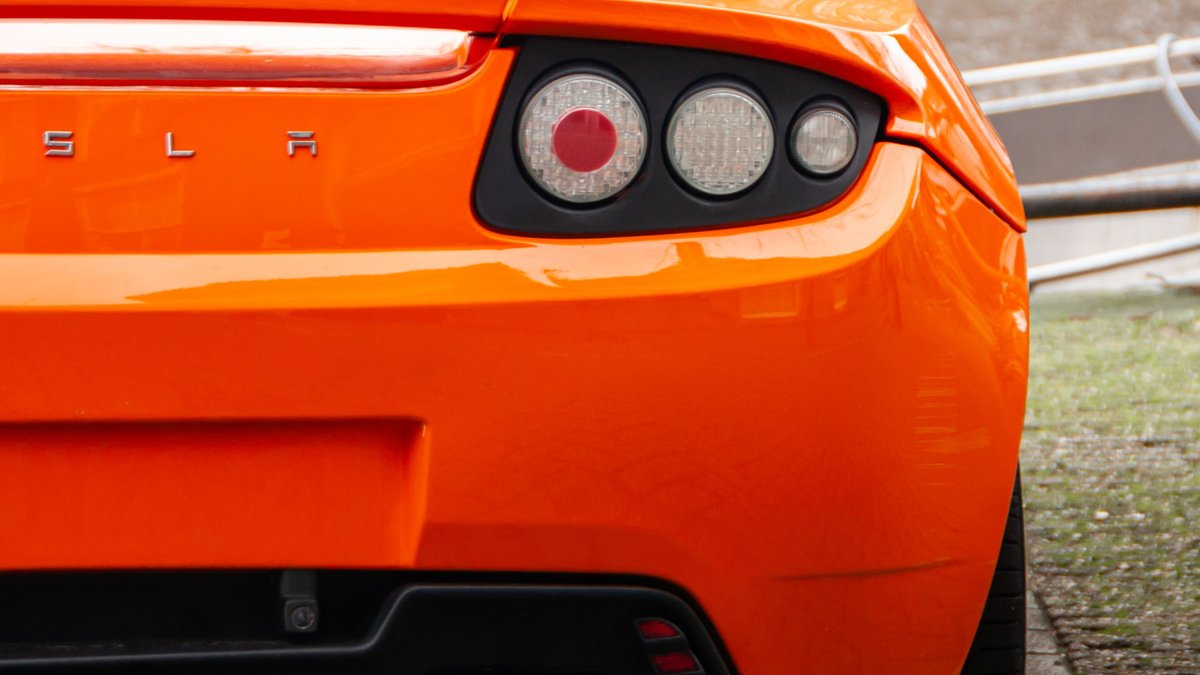
Featured photo: The earlier first-generation Tesla Roadster, not the new model. Photo: Nathan Vaganay / Pexels
Sources: Tesla: Roadster · InsideEVs: The Tesla Roadster's thrusters last seconds. Refilling takes hours · MotorTrend: How did the Tesla Roadster fly? Here's how it works · CBS News: With Tesla Roadster debut, Elon Musk shows "flying cars are real"